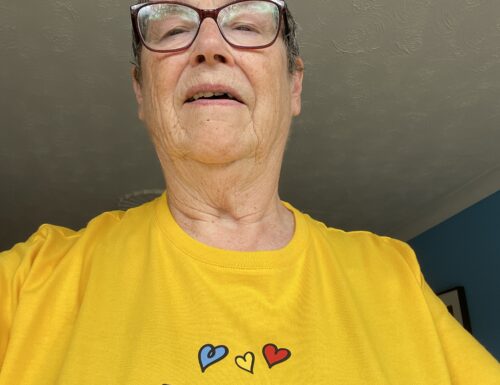
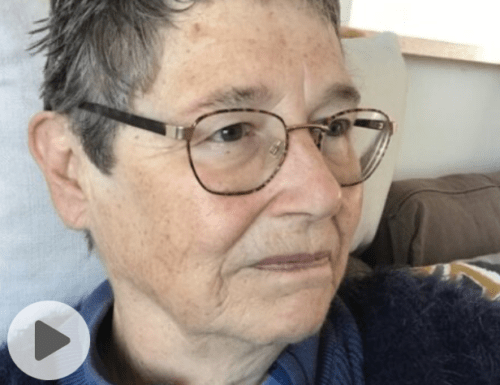
Jane Garvey interviews diarist Maxine Linnell about the new Alzheimer’s Society ad. With kind permission of Times Radio.
Jane Garvey: Have you seen the new ad campaign from The Alzheimer’s Society? Its causing a degree of controversy for its portrayal of Alzheimer’s. The campaign is called ‘The Long Goodbye’ Here is a quick clip:
“Mum first died on the 12th of May 2019 when she couldn’t work out how to prepare her legendary roast anymore. The style icon of the Covington Estate …..”
Well with dementia you don’t just die once you die again and again and again. That is the message behind the ad and it has been airing over the last week. Maxine Linnell lives with dementia and she really objects to that characterisation. She talked to me earlier.
Maxine: At the end of the video the narrator says “people die with dementia over and over again” which is sounding as if it is coming from the organisation and it’s not true and its not helpful. In fact, because of the stigma about dementia it is actually damaging. So, I know people who feel extremely hurt by this and people who feel terrified. But it’s not necessary because so many of us who are living really well. So that’s why we feel it is not a good advertisement.
Jane: Can you tell me and everybody else a little bit about yourself. When did you get your diagnosis?
Maxine: Yes, I was diagnosed in September 20222, so not that long ago and before that I was a psychotherapist for nearly 30 years and I’m a writer. I think I have brought some of my understanding as a psychotherapist to this process. I think that has been quite important in how I have seen it and experienced it, so that’s a bit about me.
Jane: And your life continues, if not exactly as it did before, but it’s still satisfying and it’s filled with other people and with life. You are still continuing to live.
Maxine: Yes, believe it or not I am alive (laughter)
Jane: It’s important to emphasise that!
Maxine: It REALLY is important to emphasise that and many of us are still fully alive. I’m in fairly early stages, so I am aware of that. There are ways I have had to adapt, there’s support that I need; some things have got more difficult, but I am living well. I’m really enjoying my life, and I find it all very fulfilling. I feel very alive.
Jane: I am trying to imagine what went through the heads of the people who put together the campaign for the Alzheimer’s Society and let’s be clear – there job is to raise money and therefore they are probably bound to be fairly emotive, and it may very well be working. For all I know they could be getting lots of donations. What do you say about that?
Maxine: Well, I don’t think it’s a very ethical way to raise money. To do things which are against their own beliefs. They’ve got pages on their website saying how you can live well with dementia. And yet they are putting out this advert; so, I am very puzzled by it myself. It kind of doesn’t make sense, and what they are saying in response to those of us who contact them is that what they are doing is telling the ‘unvarnished truth’. I just don’t believe that I don’t experience that, I don’t believe it, and I know so may people who are really distressed by this.
Jane: You hinted before that you believe that this is unnecessarily frightening
Maxine: Yes, I think so. The problem is that you know there is such a stigma around dementia anyway. It’s everywhere isn’t it. Everyone is afraid of losing a word because it might mean that there is something wrong and they might get dementia. That exists well before a diagnosis happens. So that’s in the air around us; so when a diagnosis happens someone is already feeling like they are not doing things the way they used to do, that they are forgetting things, they may be criticised for getting things wrong or people may feel sorry for them. Some of that happened a bit for me. So, after diagnosis there’s a huge shock there and like what is my life going to be like now. And it’s very easy to tip that into a kind of hopeless place.
Jane: Maxine, can I ask you did you initially feel diminished by your diagnosis?
Maxine: Yes. To some extent I had decided that I wanted to get diagnosed early if it ever happened to me. I had a very close friend who died during lockdown with dementia, and I learnt a lot from that. There was one time where it really hit me was when I went into my local library, and I was talking about dementia and one of the people said to me “You haven’t got dementia”. Yes, I have. Someone said “Well I think it’s the carers we need to think about. It’s the carers I’m worried about”. And it is not that we shouldn’t worry about the carers, of course we should, but there’s a kind of attitude as if we have gone already and that’s a very disturbing feeling to have that people aren’t seeing you. Like you are not there. It’s quite a shock and it took me a while to get the other side of that and to meet other people with dementia who felt the same way and realise that I didn’t have to sit in a room and watch the tele. I could still live a life, but it was changed, I could still live a life that matters.
Jane: Has this campaign from the Alzheimer’s Society set you back a little bit?
Maxine: Well, you know I was so angry when I saw it first. I was just incandescent. It was just everything in me said this isn’t right. So, the only thing I could do with that was start a petition, which I’ve done online. We’ve just now got 800 signatures on it. So, it hasn’t set me back it has made me feel more like there is some unity between people and something needs to change. It’s not that I need to change – it is our whole view of dementia needs to change.
Jane: Would you like the campaign to be completely withdrawn?
Maxine: I would – I just think there are so many organisations now who are coming forward and saying this is just not acceptable. It’s not just individuals. I just think this is damaging. I certainly know of someone who was recently diagnosed who was feeling like killing themselves after seeing the film. That’s just not okay, is it?
And it’s not that I’m in denial. I know I am going to die. I know this disease is progressive. I know that things are going to happen that are really uncomfortable and we are all going to die. I could die in ten years – I will be eighty-five then and I could die anyway couldn’t I. Death is there; change is there we are all going to change. So, I don’t see any need to put this forward.